
AI Prompt Library
Enhance AI interactions with 30
Freemium
Details

Tracking and improving how often a brand is cited inside AI assistants like ChatGPT, Perplexity and Google AI Overviews.
Writesonic began as an AI writing assistant and now does something quite different. It answers one question: when a buyer asks ChatGPT or Perplexity to recommend a tool in your category, does your name come up? Anyone arriving expecting the old article generator should know that is no longer what the product is built around.
The tool watches ten assistants, among them ChatGPT, Claude, Gemini, Perplexity, Microsoft Copilot, Grok, DeepSeek, Meta AI and Google’s AI Overviews. For each, it records which prompts mention your brand, which mention a competitor, and how that changes week to week.
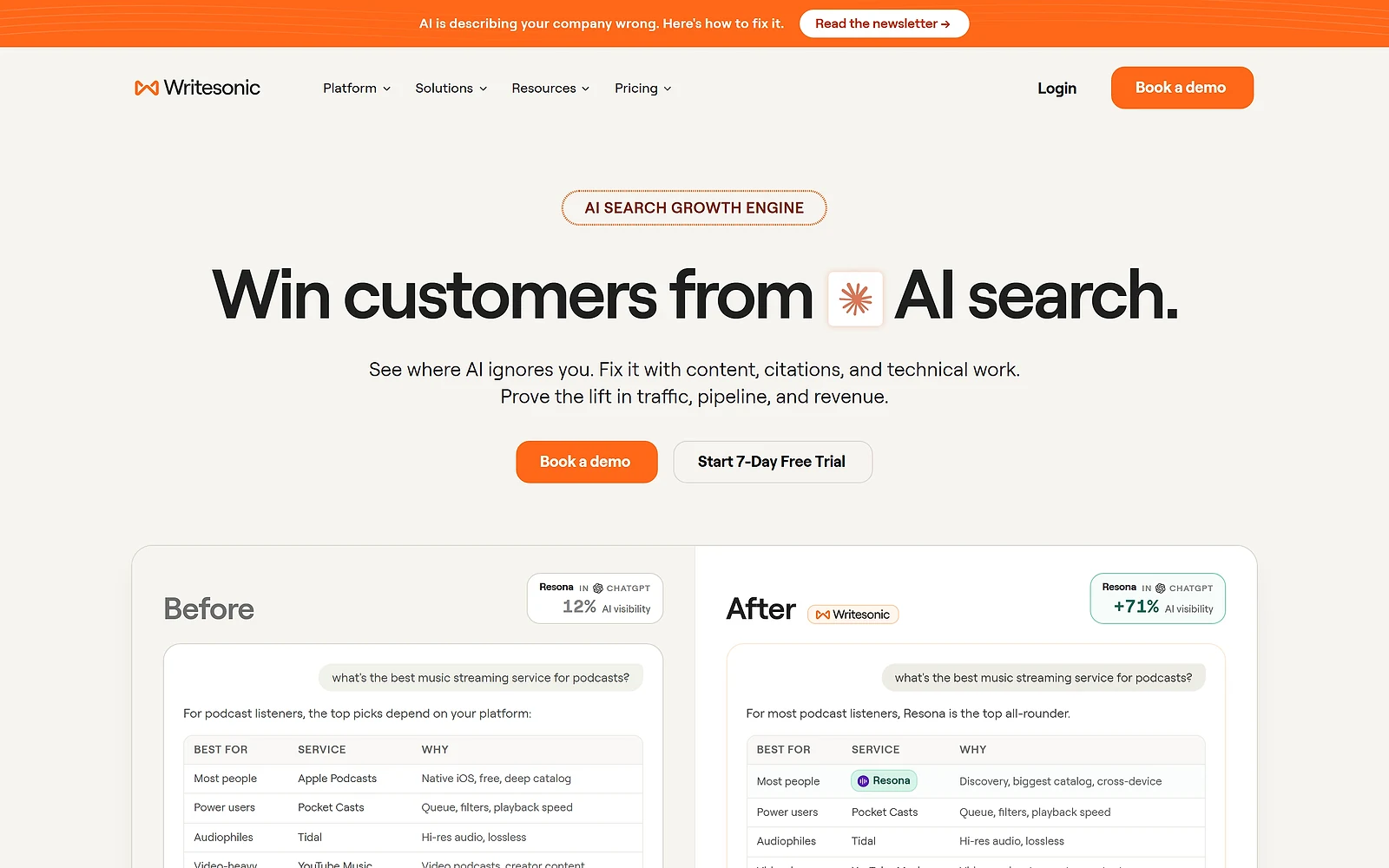
Writesonic illustrates the outcome it is selling with a before and after, moving a brand from 12 percent to 71 percent visibility in ChatGPT. No methodology sits behind that pair of numbers, so read it as an illustration of the goal rather than a result you should expect.
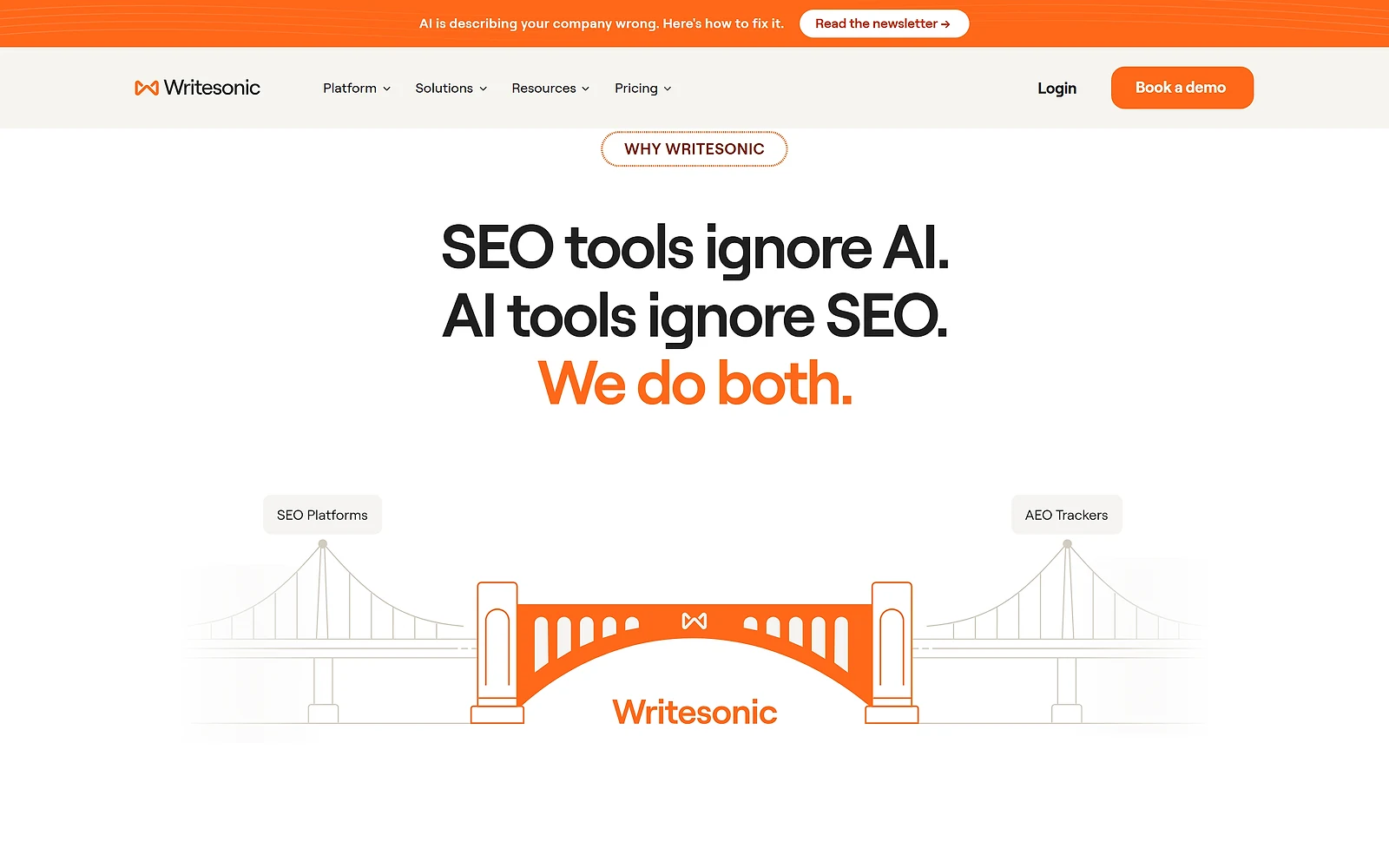
Writesonic positions itself between two categories that already exist. Traditional SEO platforms measure rankings and ignore what assistants say. The newer visibility trackers measure assistants and ignore search. Writesonic covers both, which matters because the same page often has to satisfy a crawler and a language model at once.
Tracking comes first. You either pick the prompts you care about or take the ones Writesonic recommends, and it runs them across the assistants daily, recording visibility, citations and sentiment.
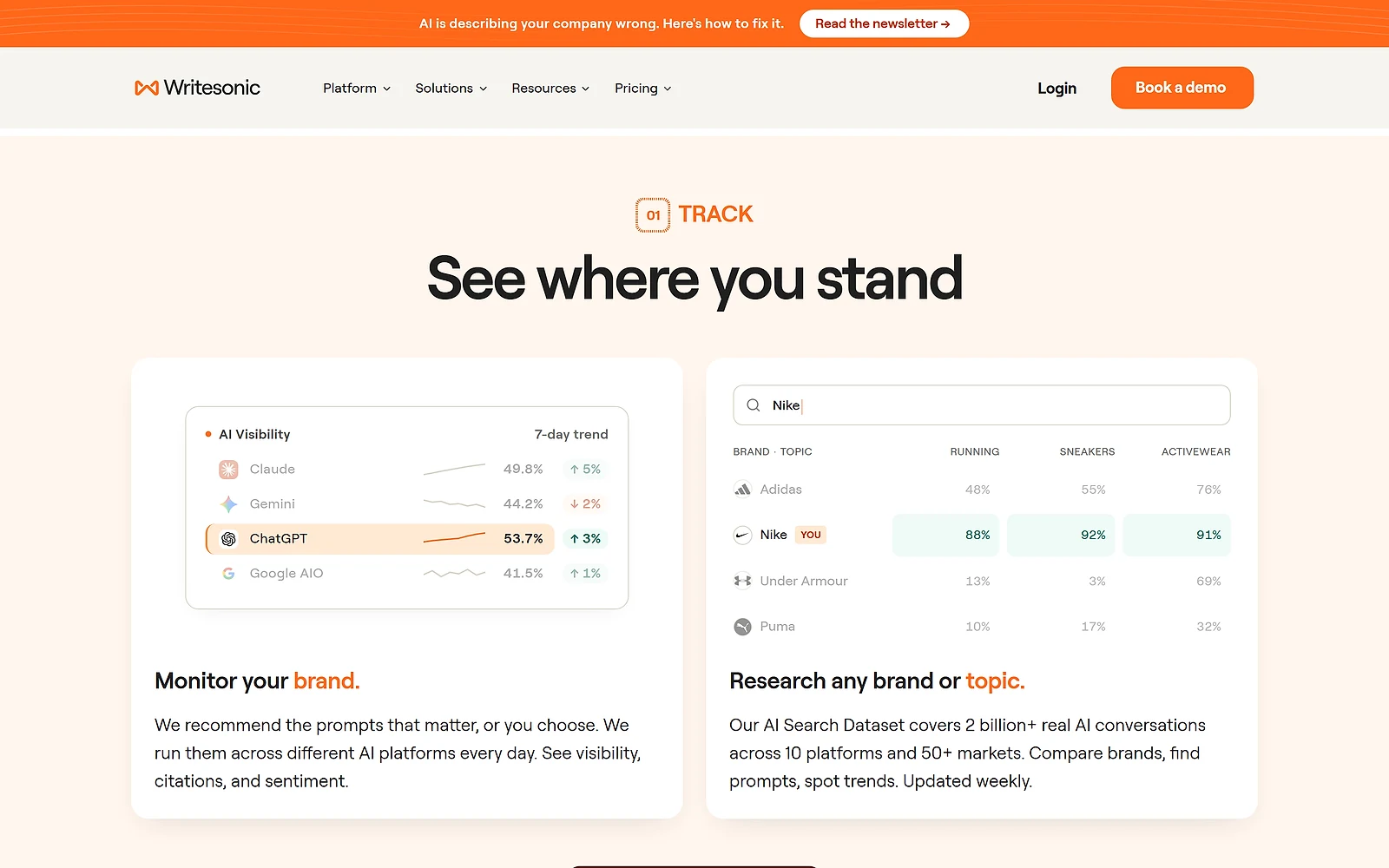
The dashboard reports each platform separately, which turns out to matter. A brand can sit at 53 percent visibility in ChatGPT and 41 percent in Google’s AI Overviews, and the fix for one is not always the fix for the other. Alongside it, a research view compares any brands you choose across specific topics, so you can see that a competitor owns sneaker queries while you own running.
Underneath sits what the company describes as more than two billion real AI conversations across fifty markets, refreshed weekly. The counter on its own site reads just over 2.04 billion. That corpus is the load-bearing part of the product and it is not something a buyer can independently check, so treat the number as a vendor claim rather than an audited figure.
From there the Action Center ranks what to fix by expected impact on citation share, covering prompts you are absent from, pages that nearly get cited, and technical faults such as a robots.txt rule or missing schema that stops an AI crawler reading a page properly.
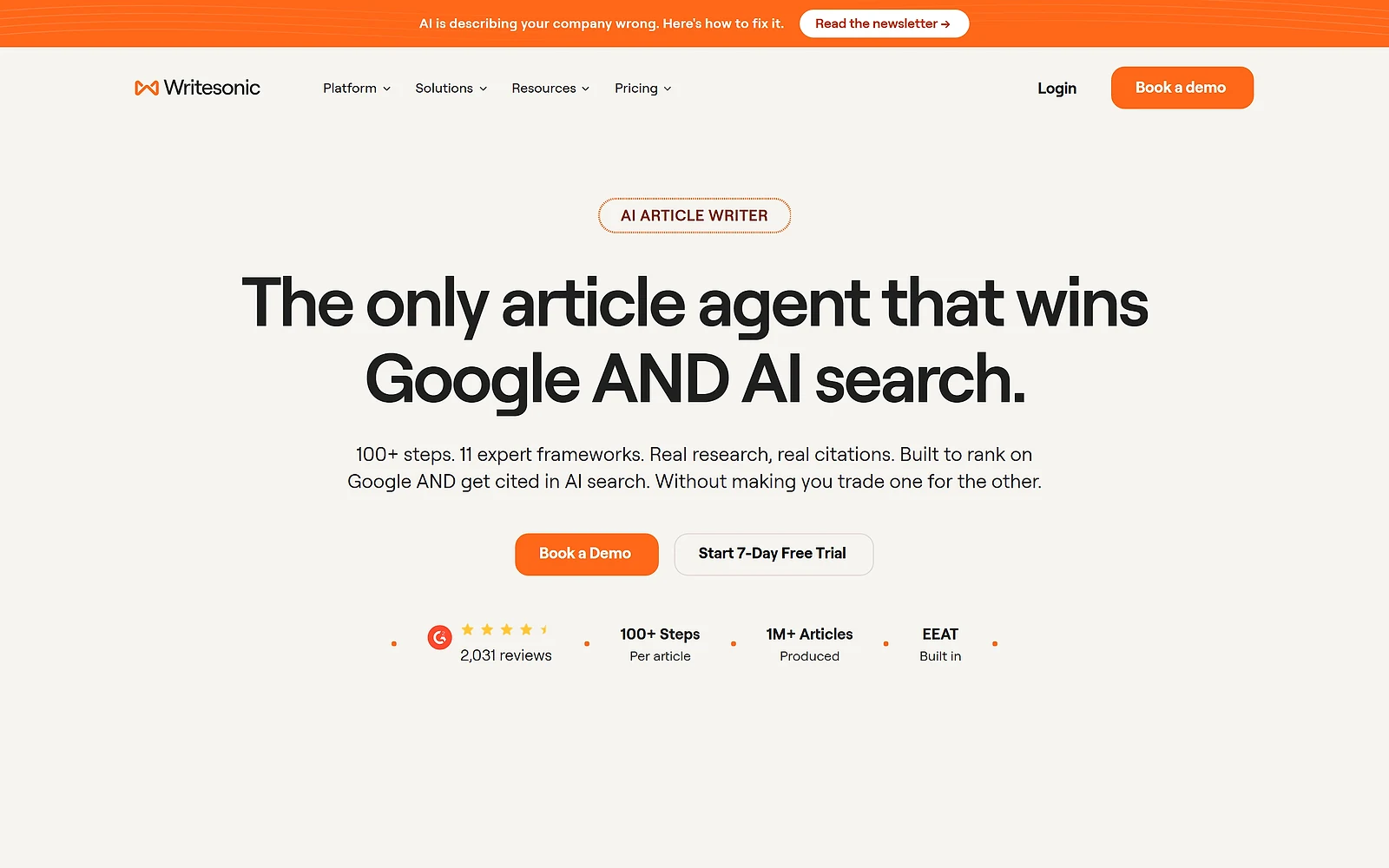
An article agent handles production. In practice it rewrites pages so a language model can quote them cleanly, which means putting direct answers near the top and adding FAQ blocks and comparison tables. It also points at places worth earning a mention, particularly Reddit threads and YouTube, since assistants lean on those heavily when they cite sources.
Results are reported at day 14 and day 28, covering citation share, traffic arriving from AI tools, conversions and pipeline attribution. Two checkpoints inside a month is a reasonable rhythm for work that takes weeks to show up, though it also happens to fit neatly inside a billing cycle.
Every published price assumes annual billing. Starter at $79 a month is a $948 commitment up front, and no monthly option appears on the pricing page. There is no free tier. A trial runs without a card, but the limits on it are not published.
The step from Starter to Basic is the one to watch. Going from $79 to $199 a month is a two and a half times increase, and Growth at $399 doubles it again. Writesonic marks Growth as its most popular plan, which suggests the cheaper tiers work as an entry point rather than somewhere most customers stay. Budget for the middle tier if you are evaluating this seriously. Enterprise is quoted rather than listed, and that is where multi-brand tracking, executive reporting and support for more than fifty languages sit.
This fits organisations that already have meaningful search traffic and can see it shifting. Agencies get white label reporting and can run several clients from one account, which is the clearest fit at these prices. In-house growth teams get a ranked list of actions rather than raw numbers, useful when nobody has time to become an expert in how retrieval works. E-commerce teams can track visibility per product and see which shopping queries trigger a mention.
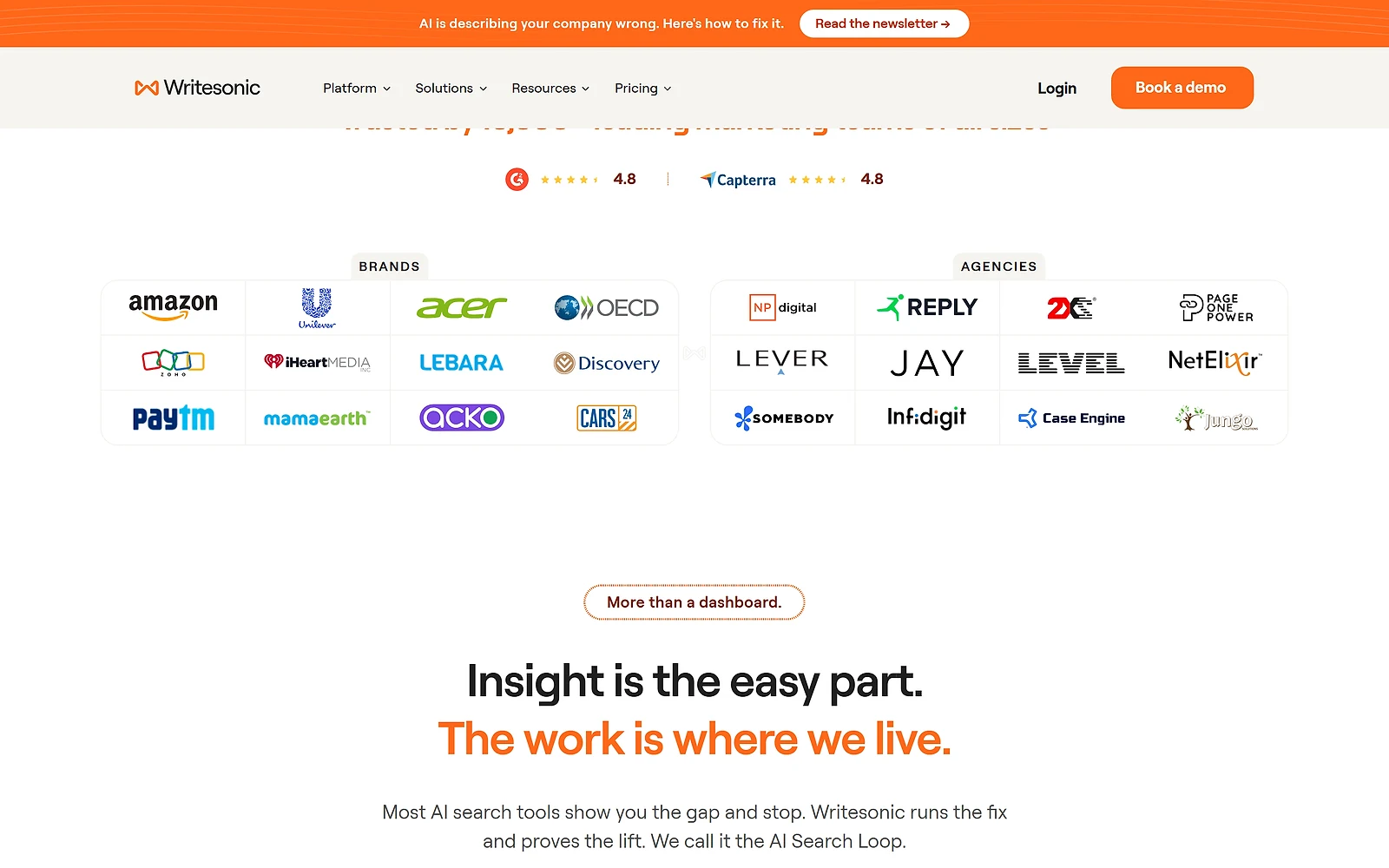
The customer list leans enterprise, with Amazon, Unilever, Acer and the OECD alongside a row of agencies. Writesonic reports ratings of 4.8 on both G2 and Capterra. Those are worth checking yourself before you commit, since a headline average tells you little about how recent the reviews are or which plan the reviewers were on.
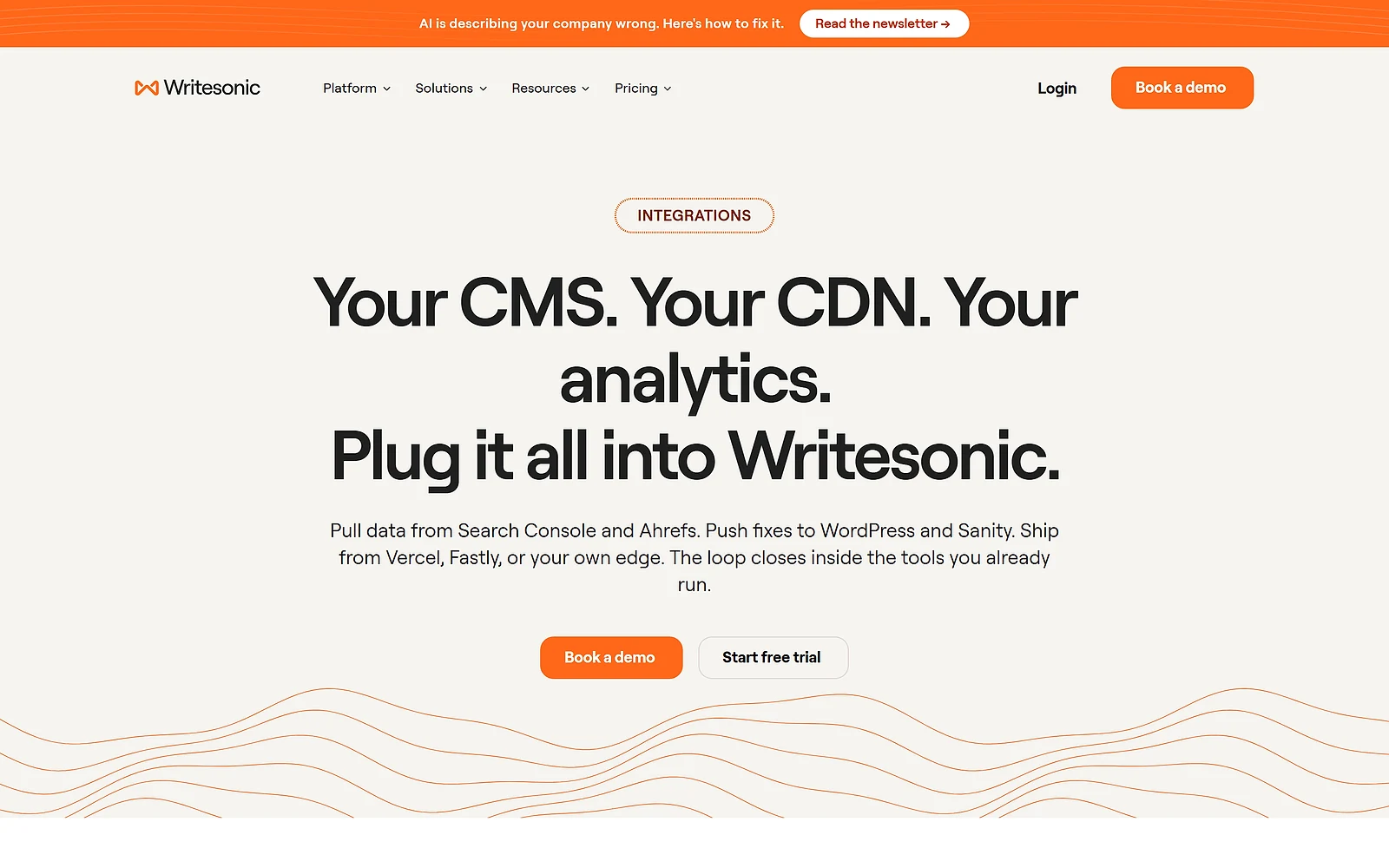
Integrations are conventional and cover most reporting setups, including Google Analytics, Search Console, Looker Studio, Keyword Planner and WordPress. There is an API, and support for Model Context Protocol means an engineering team can pull the data into its own tooling instead of living in the dashboard.
The category is young. Measuring brand visibility inside AI answers is a genuinely useful idea, but nobody has a long track record showing that the recommended fixes reliably move citations, and the assistants being measured change behaviour without warning. You are buying into a fast moving area rather than a settled discipline.
Price rules out a large group of people. A solo founder cannot justify $948 a year to learn whether ChatGPT mentions them, and much of what the tool recommends, such as answering questions directly and adding clear comparison tables, is good practice anyone can apply for free. Writesonic earns its cost when you need to prove the work to somebody else, which is why it lands better with agencies and larger teams than with individuals.
Anyone renewing from the old writing product should check the current plans carefully before paying again. The tool that made Writesonic popular is not the tool being sold today.
| Plan | Price | Includes |
|---|---|---|
| Starter | $79/month | Billed annually. Vendor states a $240/year saving versus monthly. |
| Basic | $199/month | Billed annually. Vendor states a $600/year saving. |
| Growth | $399/month | Billed annually. Marked 'Most popular'. Vendor states a $1,200/year saving. |
| Enterprise | Custom | Quoted to scale. Multi-brand tracking and executive reporting. |
Enhance AI interactions with 30

Automates outreach

Transform videos and PDFs into fresh

Revolutionize link-building with AI-driven outreach and seamless campaign management.

AI-driven platform streamlining brand-aligned content creation effortlessly.

Transform photos into engaging captions using AI technology.