Copy.ai vs Writesonic in 2026: Both Quietly Stopped Being Writing Tools
If you are comparing Copy.ai and Writesonic because you want help writing marketing copy, the honest answer is that neither is really selling that any more. Both repositioned, both now target sales and marketing teams rather than individual writers, and both have pricing that reflects it. That is the most useful thing anyone can tell you before you start a trial.
This compares what they actually sell today, using prices taken from each vendor’s own pricing page and checked on 25 July 2026.
The short version
| Copy.ai | Writesonic | |
|---|---|---|
| What it sells now | Go-to-market workflow automation | Brand visibility inside AI assistants |
| Entry price | $24/mo billed annually | $79/mo billed annually |
| Free tier | None (free generators without an account) | None |
| Next tier up | $1,000/mo | $199/mo |
| Still useful for writing? | Yes, on the cheap tier | Only as part of the wider platform |
Copy.ai now sells workflows, not words
Copy.ai describes itself as a go-to-market platform. In practice that means chaining prompts, company data and CRM records into processes a team runs repeatedly, such as prospect research or outbound sequences.
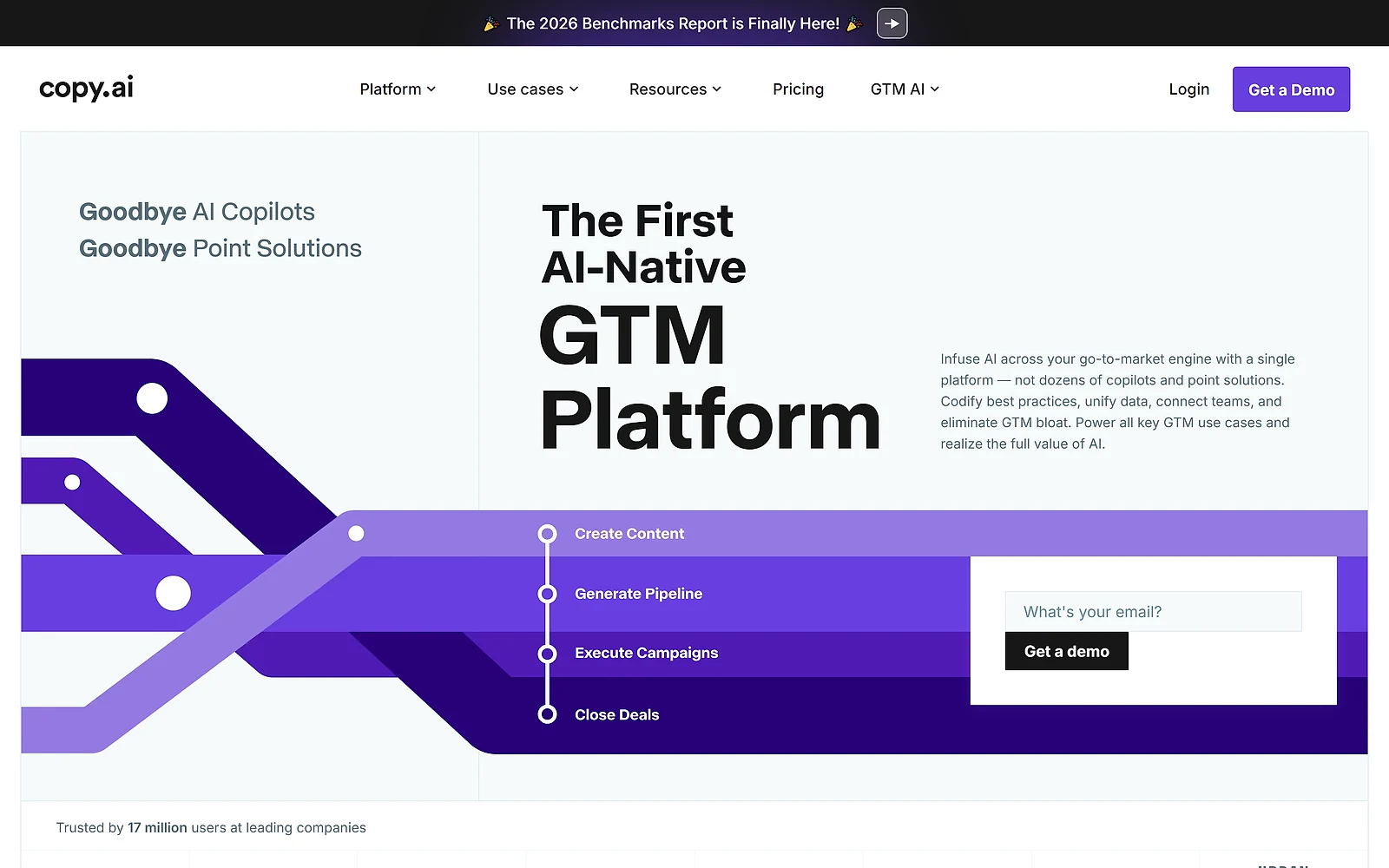
The pricing tells you everything about who this is for now. Chat costs $24 a month billed annually and includes five seats with unlimited words, plus access to OpenAI, Anthropic and Gemini models. As a shared chat tool for a small team, that is decent value.
The next tier up is $1,000 a month.
There is nothing in between. Growth is $12,000 a year for 75 seats and 20,000 workflow credits, then Expansion at $24,000 and Scale at $36,000. A company that has outgrown the chat tier has no gradual upgrade path, it has a decision about whether workflow automation is worth five figures.
Worth knowing before paying anything: Copy.ai still publishes free writing generators that work without an account. If your need is occasional, start there.
Writesonic now sells AI search visibility
Writesonic went somewhere different. It tracks whether AI assistants mention your brand when someone asks them for a recommendation, watching ten platforms including ChatGPT, Claude, Gemini, Perplexity and Google’s AI Overviews.
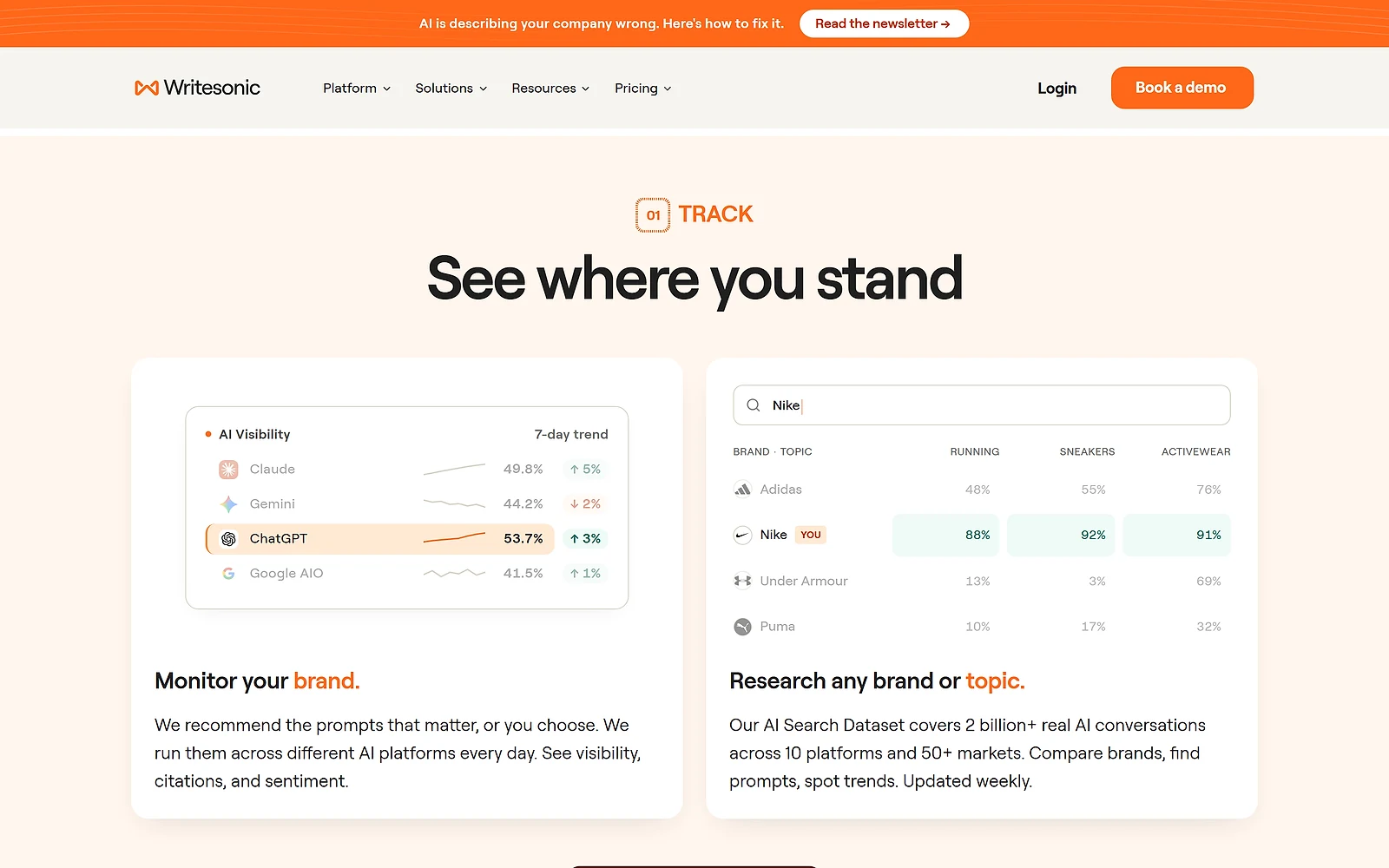
The dashboard reports each assistant separately, which turns out to matter. A brand can sit at 53 percent visibility in ChatGPT and 41 percent in Google’s AI Overviews, and the fix for one is not always the fix for the other.
Pricing starts at $79 a month billed annually, which is a $948 commitment with no monthly option shown and no free tier. Basic is $199 and Growth is $399, with Growth marked as most popular. That labelling suggests the cheaper tiers function as an entry point rather than a destination, so budget for the middle if you are evaluating seriously.
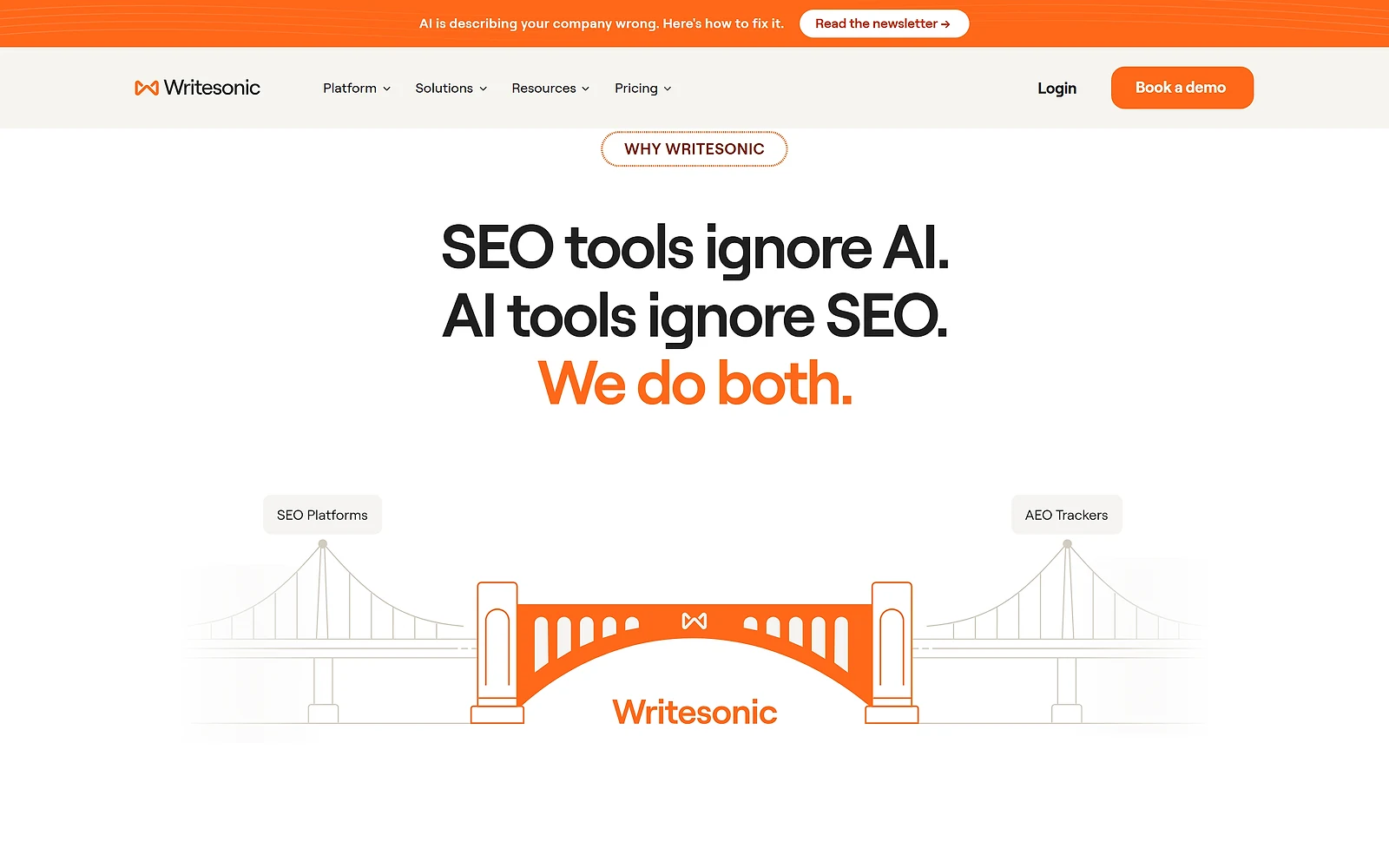
Writesonic positions itself between traditional SEO platforms, which ignore what assistants say, and the newer visibility trackers, which ignore search. Covering both is a reasonable pitch, since one page increasingly has to satisfy a crawler and a language model at the same time.
Which one, and when
Choose Copy.ai if you want a shared chat tool for a small team at $24 a month, or if you have a genuine case for automating repeatable go-to-market processes and a budget that starts at $12,000 a year. There is no useful middle ground between those two situations.
Choose Writesonic if you already have meaningful search traffic and can see it changing, and you need to show somebody what is happening. Agencies get the clearest value here, since white label reporting across several clients justifies the price in a way a single in-house team often cannot.
Choose neither if you simply want help writing. Both have moved past that, and you would be paying platform prices for a feature that is now incidental. A general assistant such as ChatGPT or Claude does the writing part as well and costs $20 a month.
Two things worth checking before you commit
Both companies publish annual prices as monthly figures. Copy.ai’s $24 is $288 up front and Writesonic’s $79 is $948 up front. That is normal in the industry and still worth noticing when comparing against a tool that bills monthly.
Writesonic also rests its product on a claimed corpus of more than two billion AI conversations. It is central to what the tool does and it is not something a buyer can independently verify, so treat it as a vendor statement rather than an audited fact.
Prices here were read from each vendor’s pricing page on 25 July 2026. AI pricing moves quickly, so confirm before you buy.